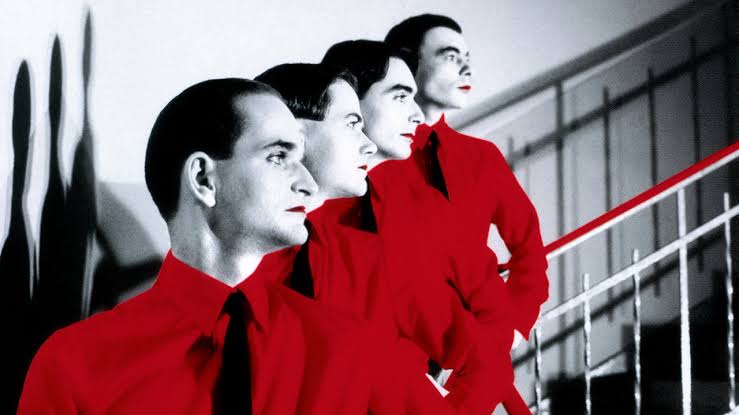
One of my best friends learned German from a band. Not from the grammar book our teacher handed out, and not from the exchange week in München that everyone else talked about. He learned it in his room, with the same records playing over and over until the words stopped being sounds and started meaning something. When the rest of us were still stuck on der, die, das, he could explain what a Taschenrechner was, a pocket calculator, literally a “pocket reckoner”, and he said it with an accent that seemed to have come from nowhere. It had come from Düsseldorf.
The band was Kraftwerk, founded in 1970 by Ralf Hütter and Florian Schneider, and in hindsight it is hard to imagine a better teacher. They sang the way almost no one sings: flat, measured, nearly spoken, every consonant in its place. No slurring, no vocal acrobatics, no feeling allowed to get in the way of the grammar. A line was delivered once, clearly, and then again. They wrote about nouns, too: the motorway, the radio, the neon light, the computer, the robot. The titles alone make a small lesson in how German builds its words. Autobahn, Radioaktivität, Neonlicht, Computerwelt, Die Mensch-Maschine. You take two things and snap them together. They also recorded in more than one language, Computerwelt becoming Computer World, so a schoolboy could hear the same song twice and notice exactly where German and English part ways.
And then there is the name. Kraftwerk is the ordinary German word for a power station, the kind of grey building you pass on the Autobahn without looking twice. But like so many German words it is two words wearing one coat, and each of them opens a door.
Kraft is strength, force, power. It is in Kraftstoff, fuel, literally “power stuff”. When a new law takes effect in Germany, it tritt in Kraft: it steps into force. When a German is exhausted after a long week, they say ich habe keine Kraft mehr, I have no strength left. And when they finally get away for a weekend by the sea or a long walk in the forest, they go to Kraft tanken, to fill up on strength the way you fill up a car.
Werk is work, but in more than one sense. It is the factory: a Stahlwerk is a steelworks. It is the mechanism: an Uhrwerk is clockwork. It is craft, in Handwerk, and the place where craft happens, the Werkstatt, the workshop. It is the work of art as well: an artist’s Gesamtwerk is their whole life’s output. And on New Year’s Eve the sky over every German city fills with Feuerwerk, fire-work, which is exactly what it sounds like.
So Kraftwerk is a power plant. Read it slowly, though, and it becomes something else: a work of power, power made into art. It is industrial and artistic at the same time, and so was everything the band did. English speakers already own both halves, slightly bent out of shape. Work is Werk, and craft grew from the same old Germanic root as Kraft before English quietly shifted its meaning from strength to skill. A Swede barely has to translate at all: a kraftverk is a kraftverk.
The records were made in a studio the band called Kling Klang, a stone’s throw from Düsseldorf’s main station. It was an unremarkable building on an unremarkable street, and its name was a very German piece of language: an onomatopoeia, the sound of things ringing and clanging, turned into a place. Walk along the Rhine there on a grey afternoon, past the old industrial harbour that has become offices and restaurants, and the music starts to make sense. It is the sound of a country that rebuilt itself on engineering and on trains that leave on time. It is order, with a pulse.
Kraftwerk never stayed inside German for long. In 1983 they released a single about cycling, and they sang it in French: Tour de France. Somewhere in Paris, two teenagers were listening very closely. My friend, meanwhile, kept his accent. Ask him today and he will still tell you that the best German teacher he ever had was a machine.
Ein paar Wörter
One pronunciation note: the German w is always pronounced like an English v, so Werk sounds close to “vairk”.
das Kraftwerk /ˈkʁaftvɛʁk/ (n. n., pl. Kraftwerke): power station. Two words in one, strength and work, and a perfect example of how German builds meaning by stacking nouns. The last part decides the gender. Das Werk is neuter, so the whole compound is too. Das Kraftwerk liegt direkt am Rhein. The power station is right on the Rhine.
die Kraft /kʁaft/ (n. f., pl. Kräfte): strength, force, power. It covers physical strength, inner strength, and the force of a law or an argument. It is one of the most useful words in German, because you can attach it to almost anything. Mit voller Kraft! At full power!
Kraft tanken /kʁaft ˈtaŋkn̩/ (loc. v.): literally “to fill up on strength”, as you would fill up a car. It is what Germans say about a weekend in the countryside, a long sleep or a holiday by the sea. Ich muss mal wieder Kraft tanken. I need to recharge.
in Kraft treten /ɪn kʁaft ˈtʁeːtn̩/ (loc. v.): to come into force. It is the language of laws and contracts, and it is almost identical to the Swedish träda i kraft. Das Gesetz tritt im Januar in Kraft. The law comes into force in January.
das Werk /vɛʁk/ (n. n., pl. Werke): work, but a word with several rooms. It is the factory, the mechanism and the work of art. When Germans admire what someone has achieved, they talk about sein Lebenswerk, his life’s work.
die Werkstatt /ˈvɛʁkʃtat/ (n. f., pl. Werkstätten): workshop, and also the garage where your car gets fixed. It is literally “work place”, and it is the kind of word you will need on any road trip. Das Auto ist in der Werkstatt. The car is at the garage.
das Handwerk /ˈhantvɛʁk/ (n. n.): craft, trade, the work of the hand. It is carpentry, baking and watchmaking. Germany takes it seriously, with a title, Meister, for those who master one.
das Feuerwerk /ˈfɔɪ̯ɐvɛʁk/ (n. n., pl. Feuerwerke): fireworks, fire-work. It also works figuratively, for a burst of anything brilliant. Das Konzert war ein Feuerwerk. The concert was a fireworks display.
der Taschenrechner /ˈtaʃn̩ˌʁɛçnɐ/ (n. m., pl. Taschenrechner): pocket calculator, literally a “pocket reckoner”. It is a small masterpiece of German word-building, and the word that gave a Swedish schoolboy his accent.
die Mensch-Maschine /mɛnʃ maˈʃiːnə/ (n. f.): the man-machine, from Kraftwerk’s album of 1978. Der Mensch means a human being, of any gender, which is subtler than the English “man”.