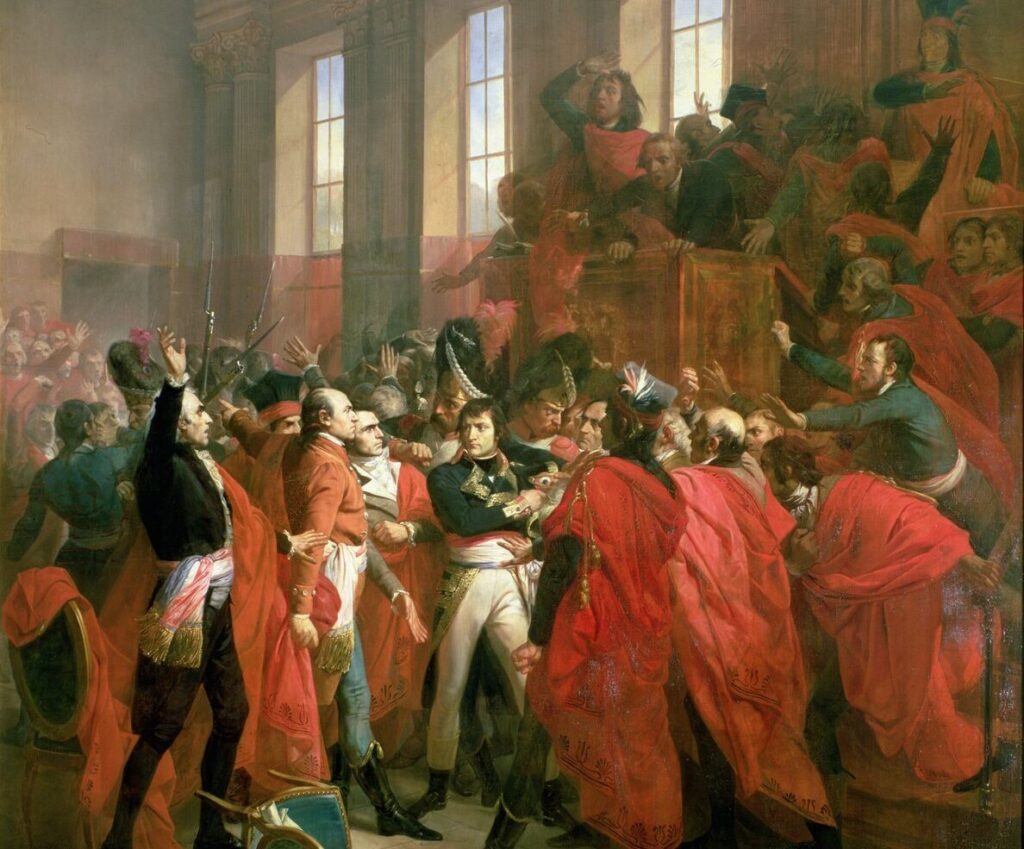
On November 10, 1799, the 19th of Brumaire by the Revolution’s own calendar, soldiers march on the château of Saint-Cloud outside Paris. Napoleon Bonaparte walks into the Orangery, where le Conseil des Cinq-Cents sits, calm and almost solemn. But cries rise from every bench: “À bas le dictateur!” (down with the dictator!”) Someone shoves him, and he is led out pale and shaken. For a moment the whole scheme seems about to collapse. Tout d’un coup (suddenly) the drums begin to roll, and Murat’s grenadiers pour into the hall and clear it. By nightfall the corrupt and faltering Directory is history. Three consuls take power, and one of them, Napoleon, is the one who counts. The French Revolution had lasted ten years and d’un seul coup, in a single blow, it ended.
France gained order after years of unrest: a centralized state, a national bank, state-run secondary schools and, a few years later, le Code civil, the legal code that still shapes French law today. The price was that power gathered in the hands of one man, who had himself crowned emperor in 1804. The expression coup d’État, a blow against the state, became posterity’s name for exactly this kind of sudden shift of power.
But the word coup has never belonged only to generals and politicians. It lives in everyday French. Two pairs of eyes meet and it is un coup de foudre, a lightning strike of love, no one could have planned. Un coup de cœur for the vintage armchair you stumble upon at a flea market and that you simply must have, sort of love at first sight. It was really expensive, but ca valait le coup, it was worth it. A friend that passe un coup de fil, a phone call, to an old friend, to ask if on va boire un coup ce soir?, if we should take a glass this evening.
The weather is part of the conversation too. The first rays of sun in May give you un coup de soleil on the nose, and on the Breton coast un coup de vent, a sudden blow of wind, that makes everyone hold on to their hats. After a long lunch in the summer heat you are hit by un coup de barre, a tiredness that only a siesta can cure. And sometimes there comes un coup dur, a setback that draws friends even closer together.
Daily life is full of small time-words built on the same noun. Tout à coup (suddenly) the light goes out. Tout is “all” or “completely,” and à coup is “at a blow. And du coup, the little word every young French person sprinkles through their sentences, explains most things: it rained, du coup (so/which is why) it became wine at home instead. It is informal and extremely common in speech, where it often works as a filler word with almost no meaning of its own.
So the same word can carry both Napoleon’s night at Saint-Cloud and an evening on a terrace. What unites them is suddenness, the feeling that something has struck and nothing will be quite as before. French loves that moment, which is why it has so many expressions for it.
Du coup: quelques mots
One pronunciation note: the p in coup is always silent, and the plural coups sounds the same, /ku/.
- coup d’État /ku de.ta/ n.m.: a coup, the seizure of power by force or by illegal means, usually by the military or a small group within the state. The expression is French in origin and used unchanged in English.
- coup de foudre /ku də fudʁ/ n.m: literally “a blow of lightning,” meaning a lightning strike or thunderbolt. Foudre is the bolt that actually strikes, unlike éclair, the mere flash. The literal sense still exists (L’arbre a été frappé par un coup de foudre, The tree was struck by lightning), but the word is used far more often figuratively for love at first sight: a sudden, overwhelming feeling that hits you without warning. It is the classic French expression for the moment you fall for someone, but it also works for a sudden, intense attraction to a place, a house or a city. Ce fut le coup de foudre dès qu’ils se sont vus. It was love at first sight.
- coup de fil /ku də fil/ n.m., fam.: a phone call, informal and friendly. You give (donner) or pass (passer) one. Je te passe un coup de fil demain. I’ll give you a call tomorrow.
- coup d’œil /ku dœj/ n.m.: a glance. You cast (jeter) one at something. Tu peux jeter un coup d’œil sur les enfants s’il te plait?
- coup de vent /ku də vɑ̃/ n.m.: a gust of wind, and also a term meteorologists use for a blustery spell of stormy weather.
- coup de main /ku də mɛ̃/ n.m.: a helping hand, the natural expression whenever you need practical help from a friend, whether carrying boxes or painting a wall. Peux-tu me donner un coup de main? Can you give me a hand?
- coup de cœur /ku də kœʁ/ n.m.: a favorite, something that wins you over instantly. French bookshops put “coup de cœur du libraire” stickers on their favorite novels, and restaurant and wine guides use it too. It is not a rational verdict but an emotional one. Ce restaurant, c’est mon coup de cœur de l’année. This restaurant is my favorite of the year.
- coup dur /ku dyʁ/ n.m.: a hard blow, a setback, such as a lost job, bad news or a failed plan. It always suggests something you must get through together. La fermeture de l’usine a été un coup dur pour la ville. The closure of the factory was a heavy blow to the town.
- tout à coup / tout d’un coup /tu.ta.ku/ – /tu dœ̃ ku/ loc. adv.: suddenly. The phrase interrupts a calm scene, so it is typical of storytelling. The two are nearly interchangeable in this sense, with tout à coup the more common. Tout d’un coup can also mean “all at once,” as in Il a tout dépensé d’un coup (He spent everything at once), so tout à coup is the safer choice when you mean only “suddenly.” Tout à coup, la lumière s’est éteinte. Suddenly the light went out.
- du coup /dy ku/ loc. adv., fam.: so, as a result, which is why. Originally a plain connector of cause and effect, it has become one of the most common filler words in spoken French, especially among younger speakers, sometimes used with hardly any meaning at all. Il pleuvait, du coup on est restés à la maison. It was raining, so we stayed home.
- boire un coup /bwaʁ œ̃ ku/ loc. v., fam.: to have a drink; literally “to drink a blow.” It is casual and social, the invitation you make to colleagues or friends when the workday ends, and it does not have to mean alcohol, although it usually does. On va boire un coup après le boulot ? Shall we grab a drink after work?
- ça vaut le coup /sa vo lə ku/ loc. v., fam.: literally “it is worth the blow,” where coup stands for the shot, attempt or effort you put in. In everyday French it means “it’s worth it,” “it’s worth the trouble” or “it’s worth a try.” It weighs cost against reward, and it is the phrase you use to encourage a friend who hesitates, whether about a long drive, a difficult conversation or a hike. It is usually followed by de and an infinitive, and the verb can be conjugated (ça valait le coup, it was worth it). The negative, ça ne vaut pas le coup (in speech often ça vaut pas le coup), means “it’s not worth the bother.” Ça vaut le coup d’essayer. It’s worth a try. Le trajet est long, mais ça vaut le coup. The journey is long, but it’s worth it.