The waiter at Osteria Ragno d’Oro, around the corner from the Ottaviano metro station not very far from the Vatican state, did not write anything down. He looked at my son, eleven years old and on his third carbonara in as many days, and gave the slow nod Romans keep for things that are correct. Bravo, he said. Not to me. To him.
Carbonara is a dish of five ingredients and a hundred opinions. Guanciale is cured pork cheek — guancia means cheek — and it is not pancetta, and certainly not bacon. Pecorino romano is the sharp cheese of the pecora, the sheep. Then come tuorli, egg yolks, perhaps with one uovo intero, a whole egg, and pepe nero, black pepper, in quantities that would alarm a Swedish grandmother.
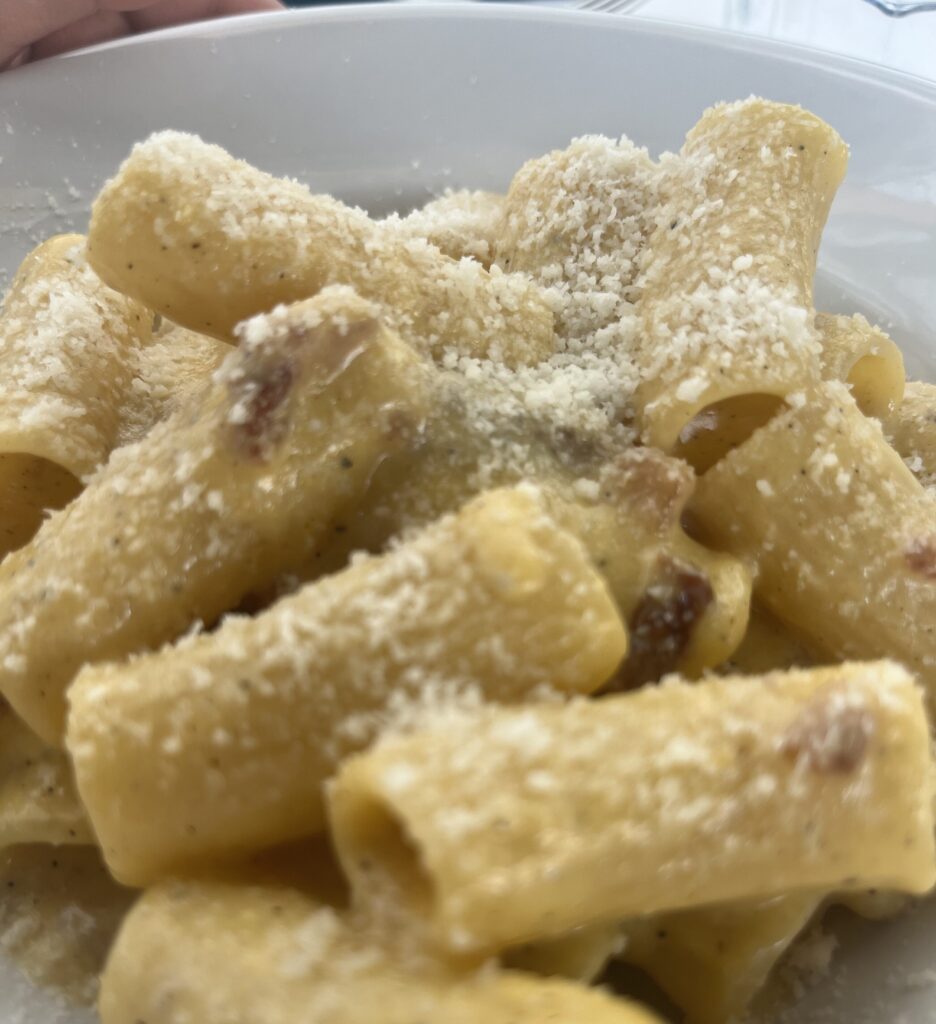
The fifth is the pasta, and here the city divides. At Osteria Ragno d’Oro it came as spaghetti; at Flavio al Velavevodetto ai Quiriti as rigatoni, ridged tubes that hold the sauce like small cups. My son could not decide which was better, which I took as a sign of a sound palate.
When he asked what was not in it, the answer came with some feeling. Niente panna — no cream. Niente aglio — no garlic. No onion, no butter, nothing green on top.
The method is short and unforgiving. The guanciale renders in a dry padella until it turns croccante, crisp. The pasta cooks in water salted with sale grosso and comes out al dente, with a ladle of acqua di cottura, the starchy cooking water, saved on the side. Then the pan comes off the flame — a fuoco spento — and the yolks, beaten with cheese and pepper, go in. Now you mantecare: stir and toss, hard and fast, until everything becomes one glossy, cremoso sauce. Too much heat and you have scrambled eggs. Somewhere just short of that is Rome.
Some say the dish belonged to the carbonari, the charcoal burners of the Apennines; others that it was born in 1944 from American rations of eggs and bacon. Rome is not troubled by the question.
On our last evening my son ran a piece of bread around his plate — fare la scarpetta, to make the little shoe — without being told. The waiter looked at the empty plate, then at him.
Bravo, he said.
Qualche parola
guanciale /ɡwanˈtʃaː.le/ — noun, masculine. Cured pork cheek, from guancia, cheek. The soul of the dish. Note the soft ci: it sounds like chah, not kee. Il guanciale deve essere croccante fuori e morbido dentro — the guanciale should be crisp outside and soft within.
pecorino romano /pe.koˈriː.no roˈmaː.no/ — noun, masculine. Aged sheep’s milk cheese from Lazio, salty and sharp. From pecora, sheep. In a Roman kitchen it is simply il pecorino, and nobody asks which one.
tuorlo /ˈtwɔr.lo/ — noun, masculine; plural tuorli. The yolk of an egg. The white is l’albume, or more homely, il bianco. Tre tuorli e un uovo intero — three yolks and one whole egg: a sentence many Roman cooks could say in their sleep.
padella /paˈdɛl.la/ — noun, feminine. The frying pan. Hold the double l. Every Italian kitchen has one pan that is never washed with soap, and it is usually this one.
al dente /al ˈdɛn.te/ — adverbial phrase Literally to the tooth: pasta with a firm bite at its centre. In Rome it is not a preference, it is the only way. Scolala al dente — drain it al dente.
acqua di cottura /ˈak.kwa di kotˈtuː.ra/ — noun, feminine The cooking water, cloudy with starch. Never pour it all away. It is the glue that turns fat and cheese into a sauce.
mantecare /man.teˈkaː.re/ — verb To stir and toss vigorously until fat, starch and cheese bind into one creamy whole. Used for risotto as much as for pasta. A verb you learn with your wrist before your head. Manteca bene, senza fretta — toss it well, without rushing.
niente panna /ˈnjɛn.te ˈpan.na/ — expression No cream. Panna is cream, niente is nothing. Two words a Roman says with the calm of someone stating a law of nature.
fare la scarpetta /ˈfaː.re la skarˈpet.ta/ — expression To mop up the last of the sauce with a piece of bread — literally, to make the little shoe. Not quite polite at a formal dinner. At a Roman trattoria, the highest compliment you can pay the cook.