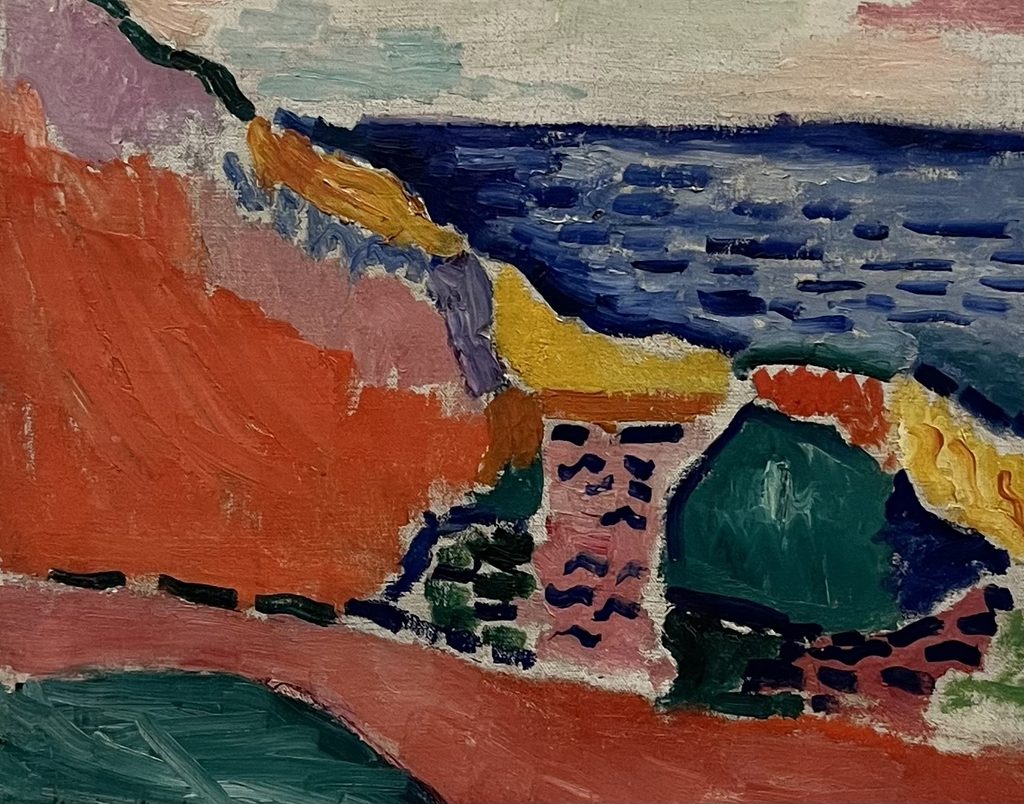
There is a moment, sometime in the early afternoon on the Côte d’Azur, when the light does something that is difficult to explain to someone who hasn’t seen it. It doesn’t just illuminate. It saturates. The white walls of the old town glow from within, the sea holds a blue that has no business existing in nature, and the shadows — even the shadows — seem to carry colour.
I noticed it the first time I came to Nice. Somewhere between the first coffee and the second walk along the Promenade des Anglais, I realised I was seeing differently. Je voyais autrement. The light here doesn’t let you be passive. It asks something of you.
Matisse understood this before I did — by about a hundred years. He arrived in Nice in 1917, at 48, originally to recover from a chest infection. He stayed for the rest of his life. Quand j’ai compris que chaque matin je reverrais cette lumière, je ne pouvais croire à mon bonheur — when I understood that every morning I would see this light again, I could not believe my happiness. He called Nice his laboratoire. The light was the experiment he never stopped running.
He had come to painting late, almost by accident, and spent years in Paris learning to see before he began to break every rule he had learned. The breakthrough came in the south, where the Mediterranean light stripped away everything he thought he knew about colour. By the time he arrived in Nice, he had already helped invent Fauvism — named, half as an insult, after the French word for wild beast, fauve — because the colours were too raw, too alive for the critics who first saw them. The Nice period that followed was warmer, more patient. Paintings of open windows, of figures in afternoon light, of the same curtain studied a hundred different ways as the sun moved across it.
At the end of his life, confined to bed after surgery, he invented a new way entirely: cutting directly into sheets of painted paper with scissors. Gouaches découpées — cut-outs — among the most joyful things in twentieth-century art, made by a man in his eighties who had never stopped believing that colour was worth the trouble.
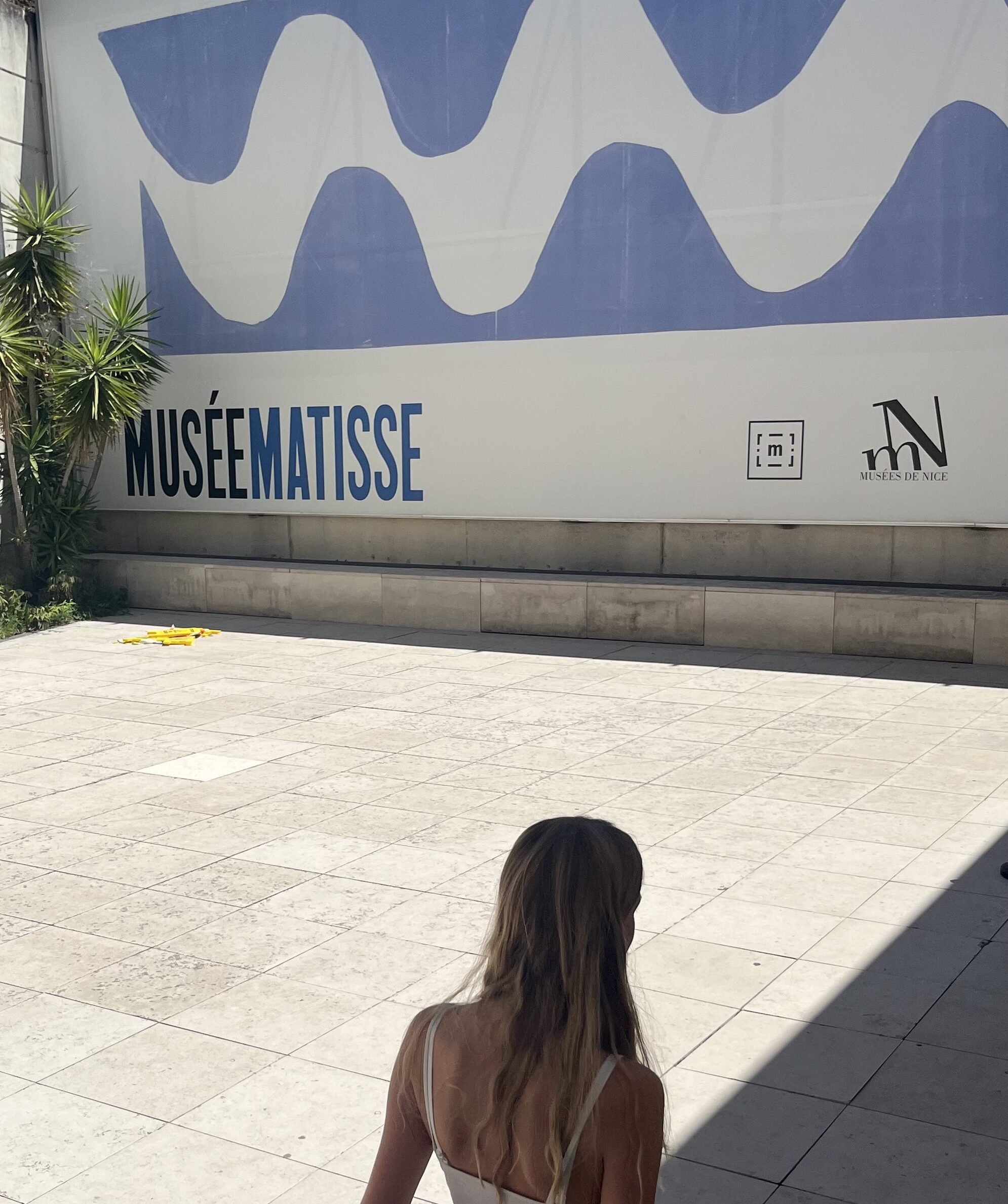
You can see all of it at the Musée Matisse, up in the Cimiez neighbourhood above the city, a fifteen-minute climb through streets that grow quieter the higher you go. The museum occupies two buildings: the Villa des Arènes, a seventeenth-century Genoese mansion painted in deep ochre that looks like it was mixed from the soil it stands on, where Matisse spent his final years; and a purpose-built modern wing added in the 1990s, with high ceilings and open spaces that make you slow down without quite knowing why. Come when the Mediterranean sun is at its most insistent — quand le soleil tape fort, as the French say, when the sun beats hard — and the olive grove surrounding the museum offers exactly the kind of shade that feels earned.
French has a different word for every way light behaves. Le soleil is the sun itself — masculine, direct, indifferent. La lumière is what the sun becomes when it touches something: a wall, a canvas, a glass of water on a table by an open window. L’éclat is the flash of brilliance, the moment it catches a surface and throws it back at you. Le miroitement is the shimmer on water, the light that won’t stay still. And then its opposite: l’ombre — the shadow, the shade, the cool dark under an olive tree at noon. In French, l’ombre is also where you go to escape the heat, which makes it both a visual phenomenon and a small act of survival.
But l’ombre is not the same as l’obscurité. Shadow presupposes light — there is always a source somewhere nearby, a sun, a lamp, a candle. L’obscurité is something else: the absence of light altogether. The sealed room, the moonless night. Where l’ombre is light’s companion, l’obscurité is its disappearance. Matisse understood the distinction instinctively. He never painted darkness. He painted shadows — and the difference is everything.
Six words where English uses two. A language, in other words, that has been paying attention.
Matisse gave it back to us. And Nice, on any given afternoon, is still making the argument that he was right to try.
Quelques mots
la lumière /la ly.mjɛʁ/ — the light, f. What the sun becomes when it touches something.
le soleil /lə sɔ.lɛj/ — the sun, m. Il fait soleil — the sun is shining. One of the first things you learn to say in French, and one of the first things you feel in Nice.
l’éclat /le.kla/ — the brilliance, m. Also: a burst of laughter, a burst of colour.
l’ombre /lɔ̃bʁ/ — the shadow, the shade, f. Where you go when le soleil tape fort. Light’s companion, never its absence.
l’obscurité /lɔp.sky.ʁi.te/ — darkness, f. Not the shadow cast by a tree or a curtain, but the absence of light altogether. What Matisse was always painting away from.
la couleur /la ku.lœʁ/ — the colour, f. Les couleurs — the colours — is how Nice looks on any given afternoon.
fauve /fov/ — wild beast, adj/m. The insult that became a movement.
je voyais autrement /ʒə vwajɛ otʁəmɑ̃/ — I was seeing differently. What happens, sooner or later, in the right light.
quand le soleil tape fort /kɑ̃ lə sɔlɛj tap fɔʁ/ — when the sun beats hard. The moment to find shade, order something cold, and stop trying to be productive.